Starting a new business venture is an exhilarating journey, but choosing the right legal structure is paramount to long-term success. Among the various corporate formats available today, the Limited Liability Partnership (LLP) has emerged as an immensely popular choice for startups, small-medium enterprises, and professional service providers alike.
An LLP seamlessly blends the structural flexibility of a traditional partnership framework with the foundational security of limited liability protection typical of a Private Limited Company. This comprehensive guide walks you through everything you need to know about registering an LLP, its inherent advantages, and the exact step-by-step framework to get your entity up and running smoothly.
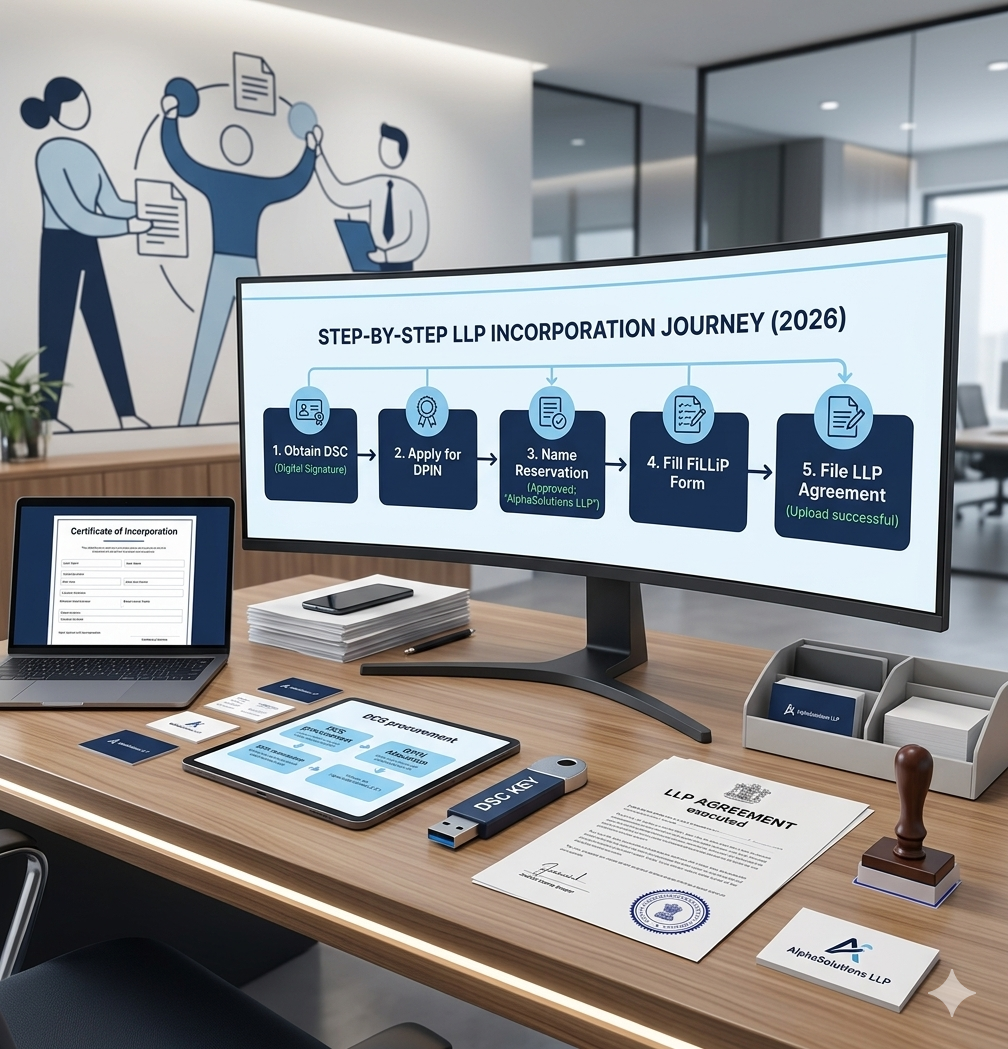
LLP Incorporation Workflow Map
1. Obtain DSC
→
2. Apply DPIN
→
3. Name Approval
→
4. FiLLiP Form
→
5. File Agreement
Why Choose a Limited Liability Partnership (LLP)?
Before diving into the procedural technicalities of registration, it is critical to understand why an LLP might be the ideal vehicle for your business operations. An LLP offers distinct structural equilibrium:
- Separate Legal Identity: Like a corporation, an LLP is a distinct legal identity separate from its partners. It can hold property, enter contracts, and incur debt in its own name.
- Limited Liability Protection: The personal assets of the partners remain strictly protected against corporate liabilities, debts, or errors resulting from the malpractice or negligence of other partners.
- Operational Flexibility: Unlike rigid corporate boards, the internal management and profit-sharing metrics of an LLP are governed strictly by a mutually agreed-upon LLP Agreement.
- No Minimum Capital Constraint: There is no statutory minimum capital requirement to initiate an LLP, allowing founders to start small.
Unlike private companies, LLPs are exempt from mandatory statutory audits until their annual turnover exceeds INR 40 Lakhs or their capital contribution exceeds INR 25 Lakhs. This significantly lowers compliance overhead for early-stage teams.
Pre-Requisites for Registering an LLP
To establish an LLP legally, certain mandatory personnel and baseline requirements must be met from day one:
| Requirement |
Minimum Criteria & Specifications |
| Minimum Partners |
At least two partners are required. There is no upper limit on the maximum number of partners. |
| Designated Partners |
At least two individuals must act as "Designated Partners", responsible for legal compliances. |
| Residency Rule |
At least one Designated Partner must be a resident of the home country (e.g., stayed in India for ≥ 182 days during the financial year). |
| Registered Office |
A physical address must be declared as the official registered office for regulatory correspondence. |
The Step-by-Step LLP Registration Process
The formal incorporation of an LLP involves a sequential interaction with regulatory authorities. Below is the precise roadmap to follow:
Step 1: Obtain Digital Signature Certificates (DSC)
Because the entirety of the registration framework is executed digitally, all designated partners must acquire a valid Class 3 Digital Signature Certificate (DSC). These certificates are crucial for securely signing electronic incorporation forms and filing subsequent annual returns.
Step 2: Apply for Designated Partner Identification Number (DPIN)
Every designated partner must possess a unique identification number, widely referred to as a DPIN (or DIN in corporate contexts). This is applied for concurrently during registration, establishing a permanent record for that individual across the regulatory database.
Step 3: Name Reservation & Approval
Choosing a unique, non-infringing name is a critical compliance milestone. The name must cleanly reflect your business domain, must not closely resemble any existing corporate body or trademark, and must end with the suffix "LLP". This is submitted through a specific name-reservation web service for formal clearance.
Step 4: Filing the Incorporation Form (FiLLiP Form)
Once your name reservation is approved, the comprehensive incorporation form (FiLLiP form) must be meticulously filled out. This integrated form consolidates parameters of your registered office, partner details, and capital contribution into a singular digital submission package.
Step 5: Execution and Filing of the LLP Agreement
The definitive pillar of your LLP is the LLP Agreement. This document codifies the internal relationship, rights, duties, profit-sharing ratios, and dispute resolution mechanisms between partners. It must be executed on judicial stamp paper and uploaded into the government portal within 30 days of receiving the Certificate of Incorporation.
Essential Documentation Checklist
To prevent processing delays or technical rejections from the registrar, ensure that the following verified documentation is assembled prior to application submission:
A. Documentation for Partners:
- Identity Proof: PAN Card / Passport / Voter ID (must be self-attested).
- Address Proof: Recent Bank Statement / Electricity Bill / Telephone Bill (not older than 2 months, matching identity names precisely).
- Passport-Sized Photographs: High-resolution digital scans.
B. Documentation for the Registered Office:
- Proof of Ownership/Tenancy: Registered Lease/Rent Agreement or Property Deed copies.
- Utility Verification: A recent Gas, Water, or Electricity bill listing the complete address.
- No Objection Certificate (NOC): A signed declaration from the property owner granting explicit permission to use the premises as the corporate registered office.
Post-Incorporation Compliance Roadmap
Receiving your Certificate of Incorporation marks the official birth of your business, but operational continuity demands instant adherence to ongoing compliance requirements:
- PAN & TAN Applications: Apply for the LLP’s unique Permanent Account Number (PAN) and Tax Deduction Account Number (TAN) immediately using the corporate incorporation certificate.
- Corporate Bank Account: Open a dedicated current account in a commercial bank using the registered LLP agreement, PAN card, and official seals.
- Annual Statutory Returns: Stay disciplined regarding timely yearly filings (such as Statement of Accounts, Solvency, and Annual Compliance Returns) to eliminate heavy penalty risks.
Ready to Set Up Your LLP Without the Legal Hassles?
At SaarSetu, we fast-track your complete incorporation journey—handling your DSC procurement, name approvals, documentation preparation, and legal filings securely. Get in touch with our advisory team today for a seamless corporate onboarding experience!